



by Sarah Duis, Indiana University Center for Rural Engagement
As the Monon South Trail takes shape mile by mile across southern Indiana, a partnership between Radius Indiana and the Indiana University Center for Rural Engagement explored emerging possibilities for communities along the route.
Through collaborative projects involving IU students, faculty, and staff across campus, the partnership spanned the 2025–26 academic year and examined how the trail could support community and economic opportunities along the corridor.
Project focuses ranged from small-business and housing development to community mapping, placemaking, and plein air painting that documented the changing landscape.
Many of the collaborations were established through the center’s Sustaining Hoosier Communities (SHC) alum year initiative, which allows former Sustaining Hoosier Communities partner communities to expand their relationships with IU through new and evolving projects.
For Radius Indiana—the region’s economic development partnership leading the Monon South Trail initiative—the emerging trail is both a recreational asset and an opportunity for community and economic development.
President and CEO Jeff Quyle said the IU partnership brought new ways of thinking to ongoing trail development.
“[They were] folks who didn’t enter the conversation with the preconceived notions and expectations we had. I think they brought some creativity that was very impactful and positive,” Quyle said. “And they brought diligence to their work as well. They really tracked down some of the minutia and hard-to-find details that help make for better decisions.”
A Trail Taking Shape
Following the historic Monon Railroad corridor, Radius Indiana is leading the development of approximately 57 miles of trail through Lawrence, Orange, Washington, and Clark counties. Once completed, the broader trail will extend 62.3 miles to New Albany, with the city responsible for the Floyd County portion.
About 20.5 miles of trail have been developed, with future construction dependent on additional funding.
The trail offers space for walking, running, biking, and community events, while putting visitors just steps away from local destinations like restaurants, shops, historic sites, and parks.
In 2023, Radius Indiana received $22.3 million through the Indiana Department of Natural Resources’ Next Level Trails program for the first phase of development. The program also funded the $5.5 million acquisition of the former rail corridor.
Credit: Jeni Waters/Indiana University
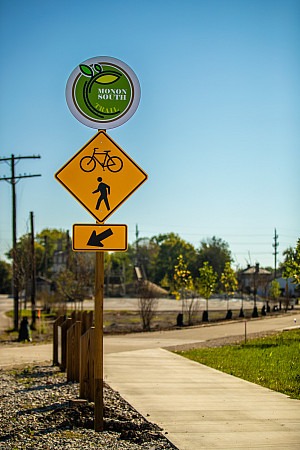
As the trail has expanded, many residents of nearby communities have embraced it as part of local life.
“They want more, more, more,” said Sadie Miskuf, who serves as Radius Indiana’s regional Main Street director. “They’re excited for the trail and they want more.”
In Salem, an original L&N railroad boxcar was restored for community use at the trailhead. The Town of Borden launched a crowdfunding campaign to restore the historic Borden State Bank building as a trail facility. The calendar of community events centered around the trail continue to grow across the corridor.
Seeing the Trail From Different Angles
At the Kelley School of Business, students working through the Center for Real Estate Studies visited six Monon South trailheads to survey users about what brought them to the trail and what amenities they wanted nearby.
They also researched other long-distance trails to see how communities have turned trail traffic into opportunities for businesses, events, and tourism.
Their work was guided by Keith Dayton, senior lecturer at the Kelley School. Dayton, who was born in Washington, Indiana, is passionate about rural community development. He said he wanted students to experience the trail firsthand and consider what might draw others there.
“My eyes aren’t the same eyes and lens that they may have. So, what would attract you to walk down this trail? What would attract you to these communities?” Dayton said.
Students at the Paul H. O’Neill School of Public and Environmental Affairs considered what increased foot traffic and development could mean for trail communities. Their projects explored ways to draw trail users into downtowns and local businesses while addressing trail upkeep, volunteer support, and future land use.
Miskuf said the work also produced tools Radius expects to use.
“They gave me some great graphics to use and a whole plan on how to start a passport program for the six communities,” Miskuf said.
Katherine Maners/Indiana University
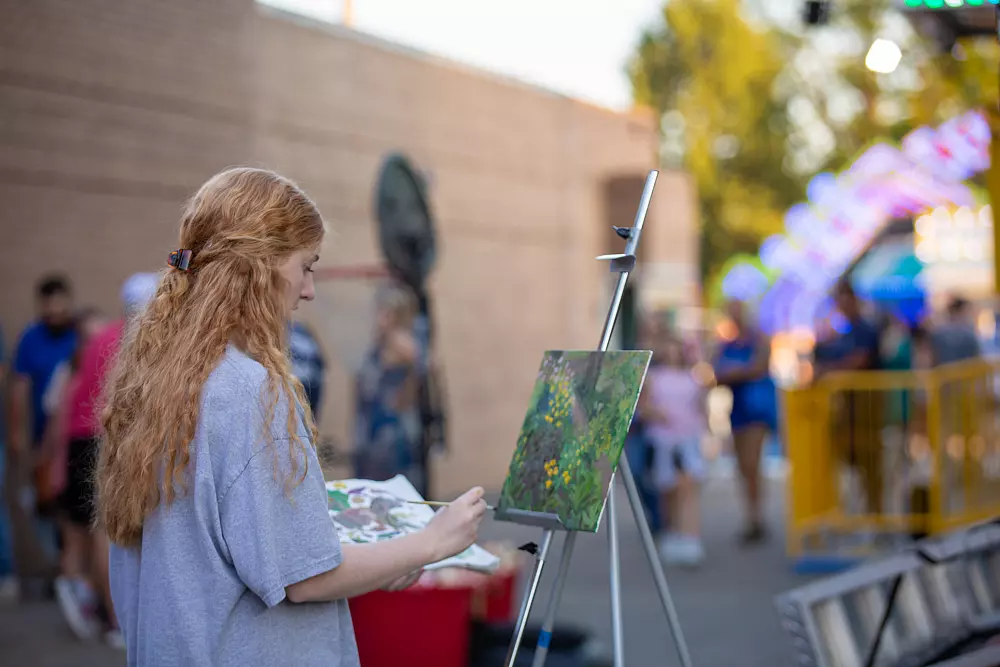
Eskenazi School of Art, Architecture + Design students have also documented the changing corridor through plein air—or open-air—painting. The collaboration began in 2024 and continued during the 2025–26 SHC alum year, creating an artistic record of communities as the trail develops.
“One of the paintings that I have is from downtown Borden, and this was the first year that they did it,” Miskuf said. “Since then, the building in the photo now has a new small business, so it’s neat to see over the years how the downtowns change because of the trail.”
At the Center for Rural Engagement, staff addressed a need for clear, community-specific trail information.
The center’s communications team created print-ready trail maps and digital Google Map layers for Mitchell, Orleans, Campbellsburg, Salem, New Pekin, and Borden. The maps display open trail sections, trailheads, amenities, and nearby destinations.
IU’s Eppley Center for Parks and Public Lands also supported the Monon South Trail from its early stages through community park planning and an assessment of the trail’s potential economic impact.
Planning What Comes Next
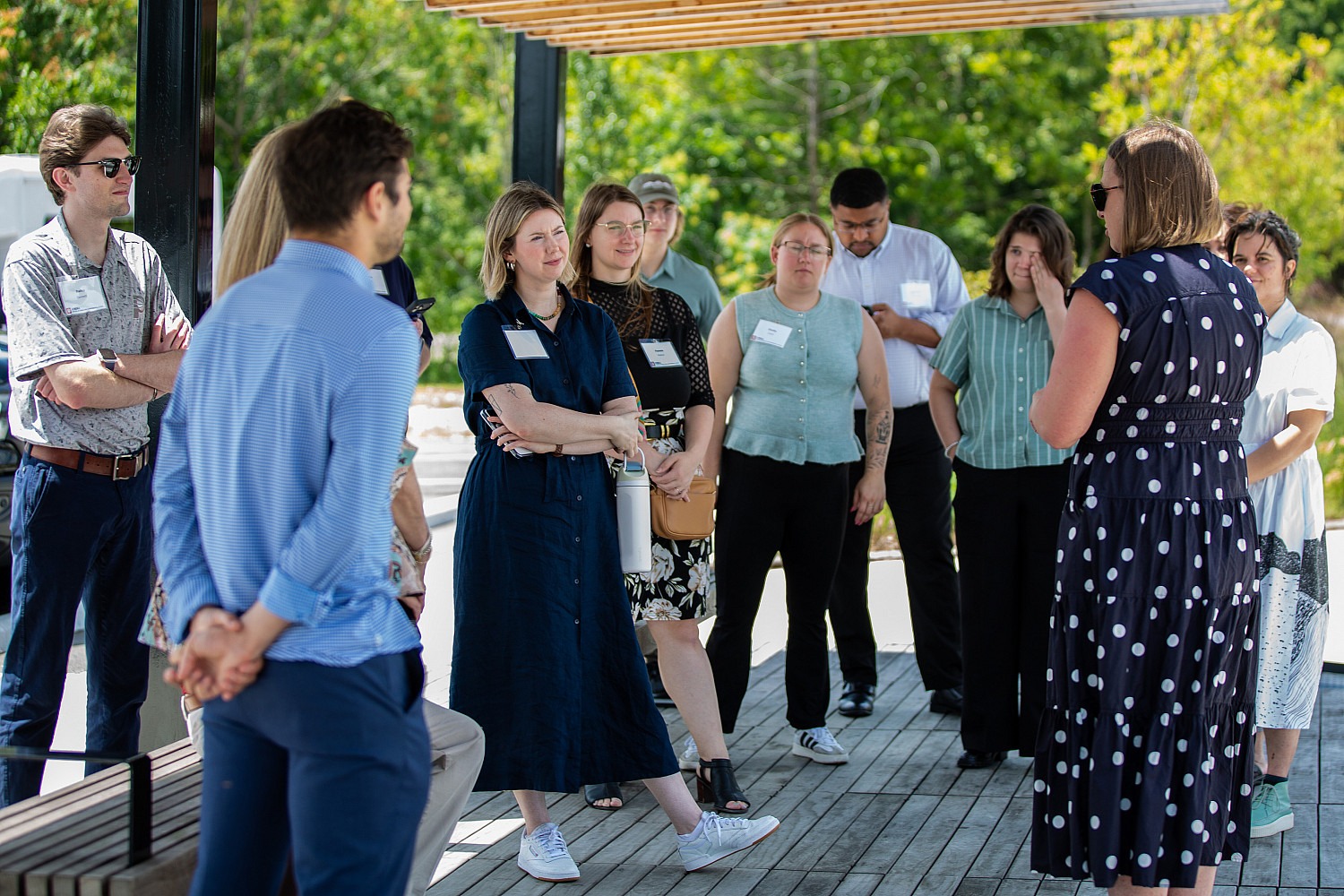
The partnership’s most recent course-based project brought O’Neill students together with Radius Indiana during O’Neill Online Week, an intensive week where Online Master of Public Affairs students travel to Bloomington to address a real public issue with a community partner.
Students visited trailheads, met with community stakeholders and local experts, and spent late nights developing their presentation.
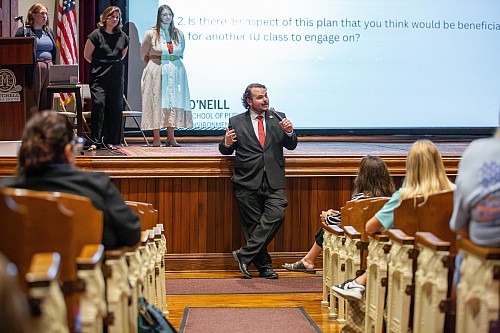
Their recommendations included strengthening Southern Indiana Trailways, a private non-profit created to implement and oversee the trail. Suggestions included more fully activating its existing board, expanding fundraising capacity, and launching a structured volunteer network.
IU O’Neill Online MPA students present Monon South Trail recommendations to Radius Indiana and community stakeholders at the Mitchell Opera House.
Credit: Sarah Duis/Indiana University
Looking back on the past year, Quyle said he appreciates that students could approach the Monon South trail without rigid ideas about what a trail project should look like.
“They were bringing that fresh perspective of, ‘Wow, this looks neat. How should we go forward with it?’ Instead of saying, ‘Well, here’s what we would have done here,’ or ‘Here’s what we did last time in another community.’ It was all wide open. It was a blank slate for them,” Quyle said.
Kyla Cox Deckard, executive director of the Center for Rural Engagement, said the partnership with Radius Indiana demonstrates the breadth of knowledge IU can bring to a regional partnership.
”The collaboration with Monon South engaged students, faculty, and staff across academic disciplines in business, public and environmental affairs, fine arts and design,” Cox Deckard said. “Monon South is a shining example of Hoosiers joining together to help Indiana thrive.”
Read the story on the Indiana University Bloomington Center for Rural Engagement’s website.