




By Miles Flynn | Southern Indiana Business Report
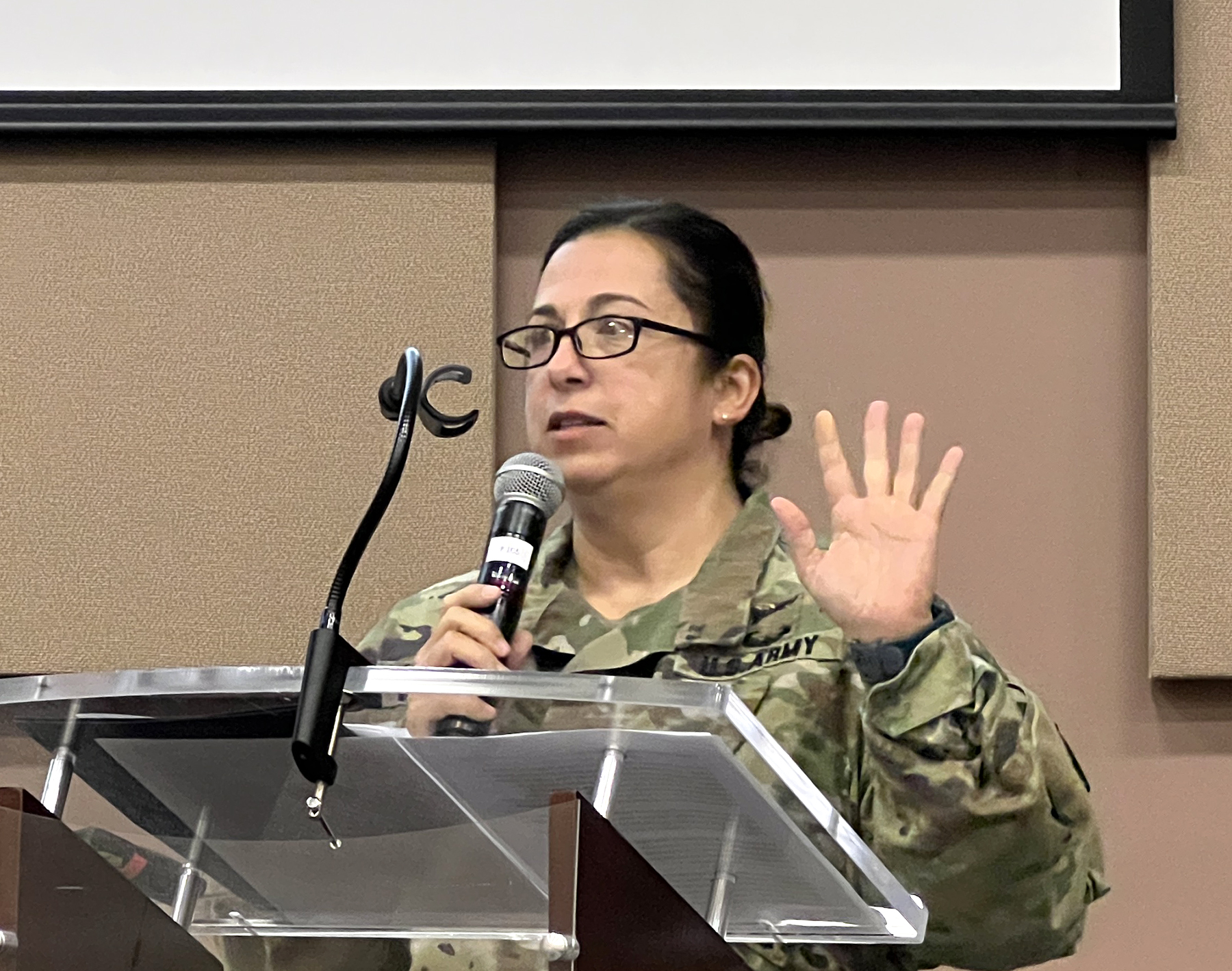
ODON — The group aiming to be the “chamber of commerce” for Crane welcomed the public to WestGate Academy Nov. 10 for the second installment of the Crane Regional Defense Group Key Leader Series. Col. Santee Vasquez, commanding officer of Crane Army Ammunition Activity (CAAA), spoke on the organization’s vital mission and stressed the importance of partnerships between the base and its neighboring communities.
Vasquez’s journey to Crane
Vasquez has been in the Army now for nearly 24 years, and while she said it doesn’t feel like it’s been that long, the mirror and the way she feels when she wakes up in the morning provide some confirmation. However, she added, every day remains exciting and brings something new. Much of her career has been in support, supply and logistics roles, and she told the audience her first exposure to ammunition came as commander of an ammunition company in South Korea.
Vasquez said her first awareness of Crane came only a couple of years ago. She was passing through the area, saw the signs, and was surprised to know there was an installation tucked away here. “I didn’t know where Crane, Indiana, was,” she told the crowd. “I will be honest.”
Then just two years after that discovery, she learned Crane would be her next assignment. She officially became the 20th commander of CAAA July 13.
Crane Army Ammunition Activity’s role

CAAA opened Oct. 1, 1977, after the Navy established its installation here in World War II, Vasquez noted, and she said both organizations at Crane enjoy a great working relationship. CAAA is one of 15-17 installations producing, storing and issuing ammunition in the United States. CAAA is home to approximately 25% of the Department of Defense’s conventional munitions — approximately 10,000 types of ammunition and related items — with the supply here valued at $9.8 billion.
As the second-largest ammunition depot in the world, CAAA utilizes 51,000 acres, or 80% of NSA Crane’s land area. It’s made up of 209 production buildings, including a 72,000 square-foot machine shop, and 1,800 storage buildings for both explosive and inert ammunition. Some of those magazines are only accessible by rail, Vasquez told the crowd, and there are approximately 94 miles of rail at Crane.
Vasquez pointed out core competencies here focus on production; storage; renovating rounds, when possible, to save taxpayer dollars; and when necessary, demilitarizing ammunition through controlled detonation or burning that is conducted in processes that are as environmentally friendly as possible. She joked that even if neighbors can’t see what’s going on, they definitely hear it from time to time. A closed system allows for processing of chemicals. And in the case of white phosphorus, Vasquez said the phosphoric acid that’s recouped is able to be sold to farmers.
While it might not have been as obvious to people outside the organization, Vasquez said the world recently did get a look at CAAA’s important capabilities. She explained its immediate response force recently helped supply the 82nd Airborne Division for the unit’s work at and around Hamid Karzai International Airport at Kabul, Afghanistan. Vasquez told the audience there’s a sense of satisfaction watching the news and seeing how CAAA’s job is impacting warfighters on the ground halfway around the world.
Striving to remain at the forefront
CAAA takes very seriously it mission of producing what’s needed and getting it where it needs to go. Vasquez said personnel work closely with customers during the design phase to ensure technical specifications are replicable in the machine shop. In addition, a surveillance sector helps guarantee consistent quality in finished products.
To remain competitive and able to meet future demands as global threats evolve, Vasquez said CAAA is taking a “holistic approach” to modernization. Of course, efforts are carefully planned and undertaken to be sure readiness isn’t impacted.
Recent examples include cutting the ribbon on a new shipping and receiving facility and an updated plating facility. On the schedule next are a modernized rail holding yard and machine shops plus a rebuilt pyrotechnic facility. That last item expected to cost approximately $74 million. And looking ahead to fiscal year 2028, the plan is to spend approximately $23 million to renovate some of the magazines at the facility. “Nothing happens fast or cheap in the military,” Vasquez warned.
CAAA is also eyeing fiber infrastructure upgrades and is working closely with Purdue University to introduce more robotics into its operations.
People a key component of success
After discussing CAAA’s modernization efforts, Vasquez stressed the aim isn’t to reduce the organization’s workforce numbers or alter its workload. Instead, she said, the goal is better quality of life and safety while ensuring productivity. Again and again during her talk, she praised the operation’s 800 civilian workers as being key to its success. “The depth of talent throughout Crane Army is just astounding to me,” she said.
Vasquez said the employees coming together from a five-county area, and many from families with multiple generations working at Crane through the decades, are truly the “backbone” of the organization. “Just the feeling of camaraderie we get at Crane is outstanding,” she said.
Community partners can help keep that talent pipeline flowing, Vasquez said, especially as more and more workers near retirement age. She explained CAAA is teaming up with Ivy Tech and Vincennes University on getting more people the training and certifications needed to excel at Crane. “We are always looking for talent,” she said.
And she said Crane continues to do all it can to foster open lines of communication and partnerships with businesses and leadership in its surrounding communities, which is why she believes the Crane Regional Defense Group is such a promising organization. “Crane is truly the surrounding communities,” Vasquez said. “… We would not be successful without you guys.”
About Crane Regional Defense Group
Crane Regional Defense Group was formed in 2020 as a subgroup of the White River Military Coordination Alliance, and the organization’s goal is to connect local communities and businesses with Crane as part of a grassroots vehicle for advocacy. Objectives include educating the region about Crane and opportunities there, supporting jobs, building consensus, and supporting defense.
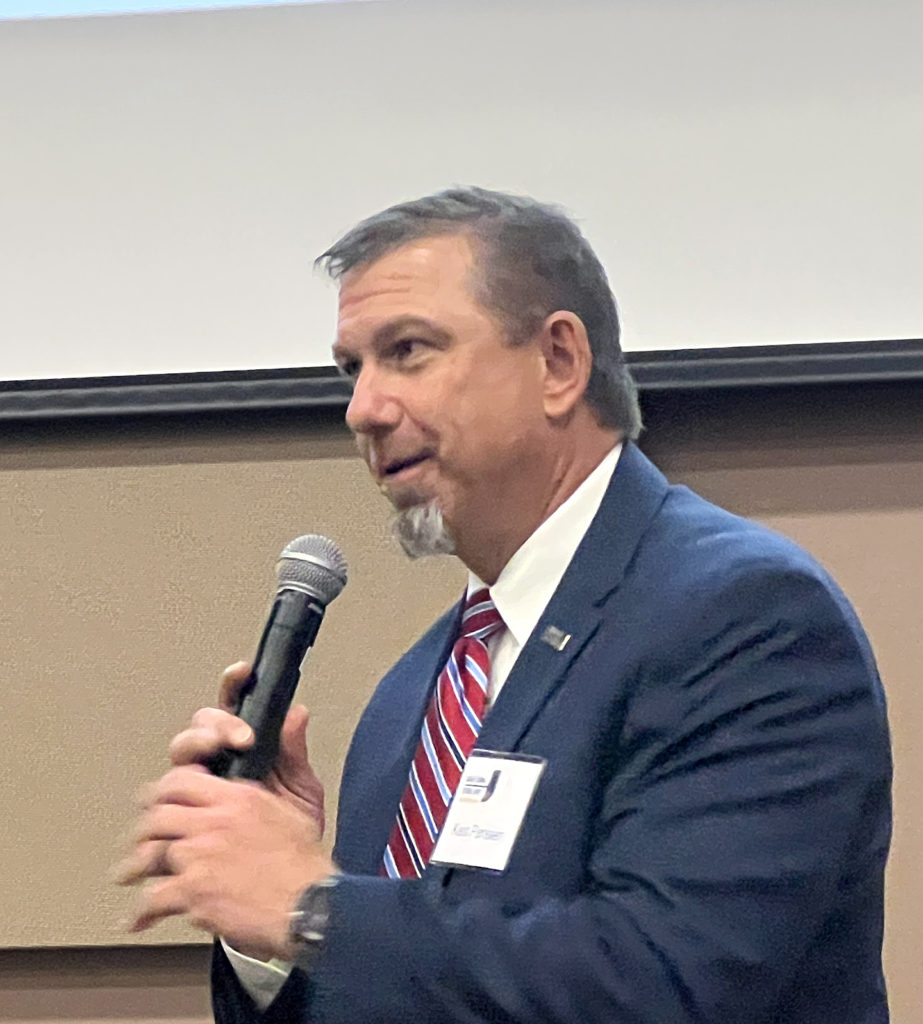
Kent Parisien, vice president of the board of Crane Regional Defense Group, reported the that the organization has now welcomed 15 partnering member agencies and businesses and is well on its way to meeting its goal of having 40 such members on board by the end of 2022.
The Key Leader Series kicked off back on Aug. 12 with a visit from Dr. Angie Lewis, technical director at NSWC Crane, and the third installment is expected sometime in early 2022.