



Carol Johnson, Southern Indiana Business Report
Declining birth rates, a growing wealth gap, shrinking labor force and the growth of AI and data centers are trends that will have a long-term effect on the US economy.
Matt Finn, chief economist of 1834 Research Institute, a division of Old National Bank, presented an overview of economic trends during the Radius Indiana board of directors annual meeting at the French Lick Resort earlier this month.
Over the next decade, the number of people over the age of 85 will increase 55%, putting a strain on Social Security and the health care system. Compounding that is the number of Americans between the ages of 10-30 will decline over the next decade.
“If you’re running a business, this is scary because that’s your future workforce,” Finn said.
Weaker demographics, Finn said, affect the economy primarily through a declining labor supply. The labor supply is experiencing a change, driven by the following factors:
- Fewer young workers slow innovation
- Aging populations reduce demand for goods and services from businesses
- Smaller workforces increase the strain on welfare systems
“At one time, there were seven people working for every person on Social Security,” Finn said. “Now there are two people working for every person on Social Security.”
The US labor participation rate has been declining since the 1990s and the rate of job creation has slowed since the COVID-19 pandemic.

Tech investment, AI
Amid these downward trends, Finn said AI and tech investment is surging rapidly. Rising investment in digital technology could deliver a substantial boost to the economy, Finn said.
“AI investment is what we’re pinning our hopes on to keep our economic engine running,” he said. “AI isn’t a job destroyer. AI can’t build teams or come up with creative solutions. What AI may do is re-allocate labor.”
The growth of data centers is another emerging trend. Demand for data centers is spurring more construction. Capital expenditures on data centers reached $25.5 billion in the second quarter of 2025. The data center vacancy rate is 1.2%, another driver of data center growth.
The United States currently owns a big advantage over other countries, holding 40% of the world’s data centers. China is a distant No.2 with about 5% of the world’s data centers followed by the United Kingdom.
Data centers will represent a change that is “truly transformational” Finn said.
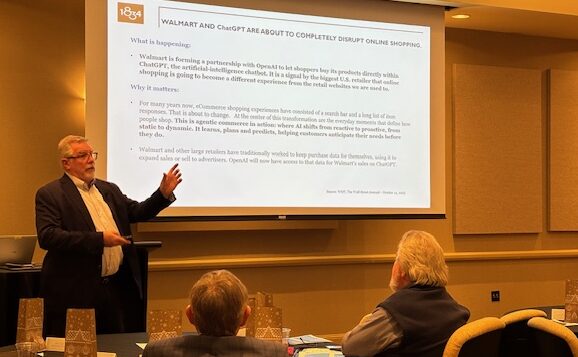
For consumers wondering just how AI will alter everyday life, Finn said a disruption to online shopping is coming with Walmart’s partnership with Chat GPT.
“It is a signal by the biggest U.S. retailer that online shopping is going to become a different experience from the retail websites we are used to,” Finn said. “For many years now, eCommerce shopping experiences have consisted of a search bar and a long list of item responses. That is about to change. At the center of this transformation are the everyday moments that define how people shop. This is agentic commerce in action: where AI shifts from reactive to proactive, from static to dynamic. It learns, plans and predicts, helping customers anticipate their needs before they do.”
Growing wealth gap
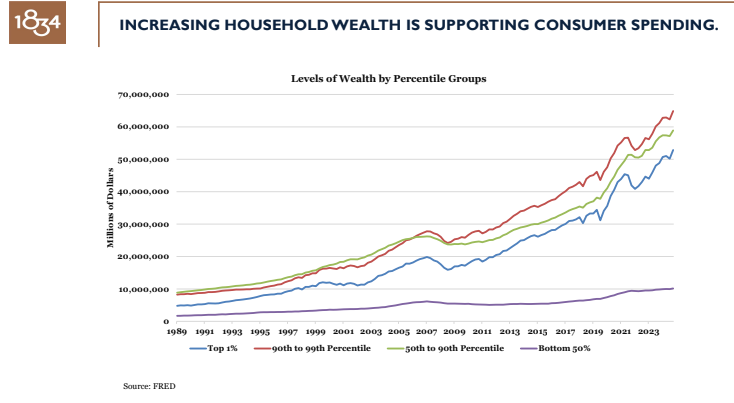
Another trend, for which there’s no quick fix, is a growing disparity in wealth distribution. A successful middle class is essential and Finn said the middle class continues to shrink.
“Ninety percent of the wealth is with the top half of the population,” he said. “The bottom half controls very little wealth.”
Finn said these Americans who live paycheck to paycheck and struggle to save will end up as renters rather than homeowners and likely won’t have a 401k.
Wealth accumulated through the stock market is concentrated among top-income households. In the last year, nearly all wealth gains went to the top 20% of households by income, Finn said, when tend to be those earning more than $150,000 after taxes.
“We can’t keep going down this road where a smaller population controls all the wealth. This is something we have to fix,” he said. “We have to have a successful middle class.”